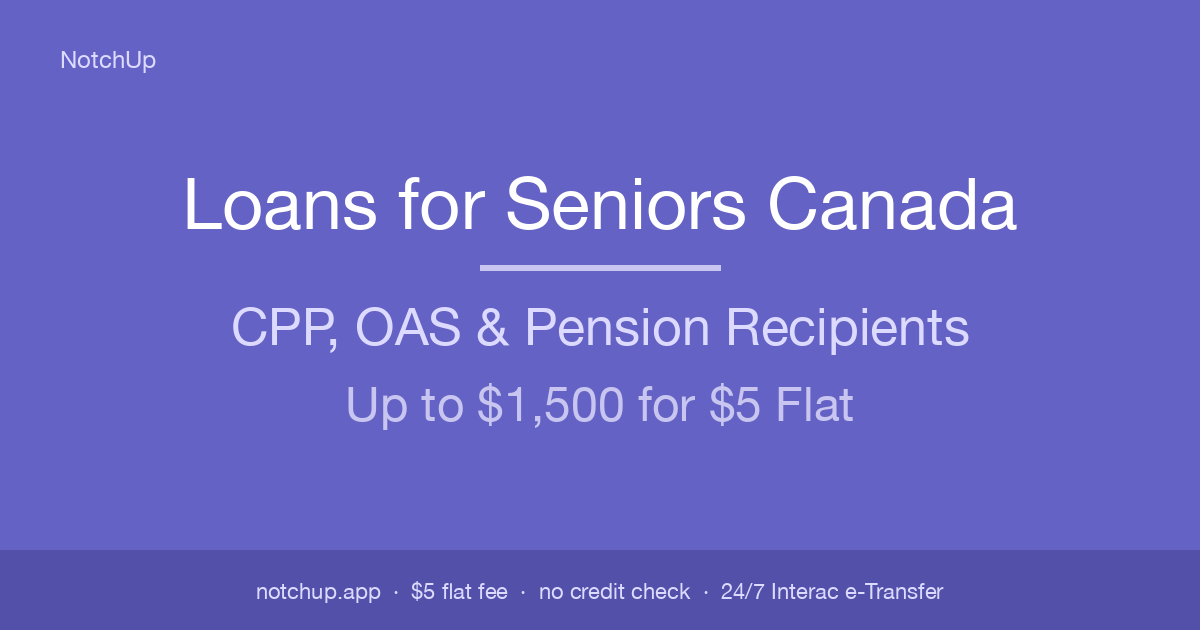
Canadian seniors on CPP, OAS or a workplace pension can borrow from four kinds of lender in 2026: a bank or credit union (cheapest, slowest, needs decent credit), an installment lender such as Spring Financial that accepts CPP and OAS at up to 35% APR, a licensed payday lender at $14 per $100 in every province except Quebec, or NotchUp, which advances up to $1,500 for a flat $5 if you have employment income alongside your CPP. On a $500 shortfall the payday route costs $70, which is 8% of the $877 average monthly CPP retirement pension; the NotchUp route costs $5 for seniors who also work. CPP and OAS pay once a month, usually in the last week, so the gap between a mid-month bill and payment day is where most of this borrowing happens. This page covers every real option, who qualifies and what each costs on a fixed income.
Key Takeaways
- There’s no special “senior loan” in Canada. Products marketed that way are ordinary payday or personal loans, and the same $14 per $100 cap and 35% criminal rate apply to everyone.
- The average CPP retirement pension for someone starting at 65 was $877.01 a month in April 2026 and the maximum is $1,507.65. OAS pays up to $751.97 a month at 65 to 74 (July to September 2026), and GIS up to $1,123.17 for a single low-income senior.
- A $500 payday loan costs $70, or 8% of average monthly CPP. The same $500 through NotchUp costs $5, or 0.6%.
- CPP and OAS 2026 payment dates are the 28th, 25th, 27th, 28th, 27th, 26th, 29th, 27th, 25th, 28th, 26th and December 22, not the last business day of the month.
- Installment lenders can’t charge more than 35% APR since January 1, 2025. Spring Financial says it accepts CPP, OAS, pension and disability income; Fairstone accepts a CPP statement as proof of income.
- Before borrowing, check GIS, your province’s seniors top-up (GAINS in Ontario, the Senior’s Supplement in BC, the Alberta Seniors Benefit) and 211 for local emergency help. None of those have to be repaid.
This article reflects CPP, OAS and GIS amounts and payment dates published by Service Canada, and lender terms, as of September 2026. OAS and GIS are indexed quarterly and lender rates change. Check your My Service Canada Account and each lender’s site for current figures.
$5
Flat fee — CPP recipients often qualify
15 min
Interac e-Transfer, available 24/7
0
No credit check, no SIN required

Canadian seniors on CPP, OAS or a workplace pension face the same cash-timing problem as working-age Canadians. Income arrives on a fixed schedule, and CPP and OAS pay on specific dates each month, but expenses don’t wait. A prescription runs out before payment day. A utility bill is due mid-month. A car repair can’t wait. These aren’t emergencies caused by poor planning; they’re timing mismatches on a fixed income.
What gets advertised as a “senior loan” or “pensioner loan” in Canada is often a standard payday loan charging $14 per $100 in every province except Quebec. On a $500 advance, that’s $70 in fees. For a senior receiving $1,200 a month in CPP, paying $70 to access $500 early means 14% of the transaction value goes to fees.
Can Canadian Seniors Get a Loan on CPP or OAS?
Yes, but the answer depends on the type of lender and the structure of your income. CPP and OAS are treated differently by different lender categories. Here’s an honest breakdown of each.
Payday lenders: accept CPP and OAS, but at high cost
Most licensed payday lenders accept CPP and OAS as qualifying income; iCash, for example, lists both. If you receive regular CPP or OAS deposits into a Canadian bank account in good standing, you can typically borrow up to $1,500 the same day with no credit check. The catch is the fee: $14 per $100 in every province except Quebec. That’s what the law allows and that’s what you’ll be charged.
Banks and credit unions: cheapest option, but strict eligibility
If you have an established relationship with your bank or credit union, a personal line of credit or a small personal loan may be the lowest-cost option available. Seniors with good credit and stable CPP and OAS income are often eligible. A bank personal loan is priced at prime plus a margin, a fraction of the roughly 365% APR a payday loan works out to at $14 per $100, and Vancity’s Fair & Fast Loan in BC lends $100 to $2,500 at 19% with no credit check. If this option is available to you, it’s almost always the right choice. The barrier is approval time: bank loans take days, not minutes.
Earned wage access (NotchUp): $5 flat, but requires employment income alongside CPP
NotchUp is earned wage access, which means it advances money you’ve already earned through employment. CPP alone doesn’t qualify because CPP isn’t employment income; it replaces it. To use NotchUp as a senior, you need employment income alongside your CPP, whether that’s part-time work, freelance income or any other earned wages showing in your bank account.
If you have both CPP and employment deposits going into your Canadian bank account, you can qualify for an advance of up to $1,500 at a flat $5 fee, with no interest on a standard advance. The application takes about two minutes, requires no credit check and no SIN. If you don’t qualify, you’ll be told immediately, with no impact on your credit.
OAS-only recipients without employment income won’t qualify for the same reason: NotchUp advances earned wages, not government benefits.
Installment lenders: higher cost than banks, but more accessible
Online installment lenders such as Spring Financial ($500 to $35,000, 9.99% to 35% APR, and it says outright that it accepts CPP, OAS, pensions and disability benefits), Fairstone ($500 to $25,000 unsecured, from 19.99%, and a CPP statement counts as proof of income) and easyfinancial ($500 to $20,000, from 29.99%) spread repayment over months or years, which lowers the monthly payment. Since January 1, 2025 none of them can charge more than 35% APR. For a one-time $500 shortfall, an installment loan may cost more over time than a single-use advance, depending on how quickly you repay.
All Options Compared — Loans for Canadian Seniors
Here is the full picture of what’s available to Canadian seniors on CPP, OAS or a pension, with honest detail on cost, accessibility and speed:
| Option | Accepts CPP/OAS? | Cost | Speed | Credit Check | Best For |
|---|---|---|---|---|---|
| NotchUp (EWA) | CPP + employment income | $5 flat | ~15 min, 24/7 | No | Seniors who also work, by far the cheapest option |
| Payday lender (e.g. iCash) | Yes | $14 per $100 | Same-day | No | If you don’t qualify for EWA and need money today |
| Bank / credit union | Yes (with good credit) | 6–15% APR | 1–5 business days | Yes | If you have an existing relationship and can wait |
| Installment lender | Yes (Spring Financial says so; Fairstone takes a CPP statement) | 19–46% APR | 1–3 business days | Soft check | Larger amounts repaid over time |
| Bree | Yes, government benefits count | Free (standard) or small express fee | 1–3 days (standard) | No | Up to $750, smaller advances on regular income |
The hierarchy is straightforward: bank or credit union first if you can qualify and can wait. NotchUp second if you have employment income alongside your CPP and need money today. Payday lender or Bree third if you’re on CPP alone and need cash fast. Installment lender for larger amounts over a longer repayment period.
CPP Payment Dates 2026 and the Timing Gap
CPP and OAS payments arrive on fixed dates each month, published by Service Canada. In 2026 the dates are January 28, February 25, March 27, April 28, May 27, June 26, July 29, August 27, September 25, October 28, November 26 and December 22, usually a few business days before month-end rather than the last business day. When payment arrives on January 28 but a bill was due on January 15, a two-week gap exists, and that’s the gap fast-cash products fill. Our CPP and OAS payment dates guide has the full calendar.
The average CPP retirement pension for someone starting at 65 was $877.01 a month in April 2026, and the maximum at 65 is $1,507.65. OAS pays up to $751.97 a month at 65 to 74 and $827.17 at 75 and over for July to September 2026, indexed quarterly, and the Guaranteed Income Supplement adds up to $1,123.17 for a single low-income senior. These aren’t high-income amounts, which makes the cost of a payday loan fee proportionally more significant than for a working-age borrower with a larger monthly income.
Real Cost: What a Loan Actually Costs on a Senior’s Income
To understand the true cost of a payday loan on a fixed income, compare the fee to the income, not just to the loan amount. Here’s how the numbers look for a Canadian senior receiving the average CPP retirement pension ($877 a month):
| Loan Amount | Payday Loan Fee (national max) | Fee as % of Monthly CPP ($877) | NotchUp Fee | NotchUp Fee as % of Monthly CPP |
|---|---|---|---|---|
| $200 | $28 | 3.4% | $5 | 0.6% |
| $400 | $56 | 6.7% | $5 | 0.6% |
| $500 | $70 | 8.4% | $5 | 0.6% |
| $700 | $98 | 11.8% | $5 | 0.6% |
| $800 | $112 | 13.5% | $5 | 0.6% |
A $500 payday loan costs a senior $70 in fees, 8% of their entire monthly CPP. The same $500 advance through NotchUp costs $5, 0.6% of the same monthly income. The gap is stark because the payday fee scales with the loan amount while the NotchUp fee stays flat at $5. For seniors with employment income alongside CPP who qualify, the saving on a single advance can equal half a week of groceries. The APR Illusion explains why the dollar amount, not the APR, is the number to compare on a short loan.
Key Takeaway
A $500 payday loan costs a Canadian senior $70 in fees — 8.4% of average monthly CPP. The same $500 advance through NotchUp costs $5. For CPP recipients who qualify for NotchUp, the savings on a single advance can equal half a week of groceries.
How NotchUp Works for Seniors on CPP
NotchUp, licensed in BC (#86443) and regulated by Consumer Protection BC, is earned wage access (EWA), a product that advances money you’ve already earned through employment before your next payday. Because it advances earned wages, not government benefits, you need employment income alongside your CPP to qualify. CPP alone isn’t enough.
That means NotchUp is an option for seniors who work part-time, freelance, or have any other employment income depositing into their bank account alongside their CPP. If your bank history shows both employment deposits and CPP deposits, you can apply. The application takes about two minutes, requires no credit check and no SIN. If you qualify, funds arrive by Interac e-Transfer in about 15 minutes, at any time of day, including evenings and weekends. Approval is based on current account activity, so a past approval doesn’t guarantee the next one.
Repayment is automatic. When your next payment arrives, NotchUp collects what you borrowed plus the $5 fee. There’s no manual repayment and no due date to forget. An advance covers a timing gap between a bill and a payment date, though; it isn’t a fix for a month where spending runs past income.
If CPP or OAS is your only income and you don’t have employment income, NotchUp won’t work. Your realistic options are a licensed payday lender, Bree (free on standard delivery for government benefit recipients), or the government programs listed below.
What About Government Programs for Senior Emergencies?
Before turning to any lender or cash advance product, check whether free money is available first. Several government programs help seniors with cash shortfalls, and most are underused:
- Guaranteed Income Supplement (GIS): If your income is below the threshold, you may be eligible for GIS on top of OAS. The maximum for a single senior is $1,123.17 a month for July to September 2026. If you’re not already receiving GIS and your income is low, check your eligibility at canada.ca.
- Provincial top-up programs: Ontario’s GAINS pays up to $92 a month, BC’s Senior’s Supplement up to $99.30 a month for a single senior, and the Alberta Seniors Benefit up to $3,946 a year. Other provinces have equivalents; check your provincial government site.
- One-time emergency assistance: Many municipalities and social service agencies offer emergency financial help for seniors. Dial 2-1-1 or visit 211.ca to find local resources anywhere in Canada.
- Advance on pension: Some employer pension plans allow a one-time advance on future payments. Contact your plan administrator directly.
- Credit union small loans: Some credit unions offer small-dollar loans at far lower rates than payday lenders, such as Vancity’s Fair & Fast Loan at 19%. Your existing banking relationship matters here.
These programs don’t provide instant cash. But if you’re in a recurring cash-timing situation, fixing the underlying income gap is worth more than repeated advance fees.
Predatory Lending Targeting Seniors: What to Watch For
Seniors are disproportionately targeted by predatory lenders. Several tactics are used specifically to extract fees from people on fixed incomes:
- Loan sharks disguised as “senior-friendly” lenders: Websites or flyers advertising “loans for pensioners, no questions asked” with fees above the legal cap are unlicensed and illegal. There’s no special “senior loan rate”; the caps apply to everyone.
- Reverse mortgage misrepresentation: Reverse mortgages let homeowners 55 and over access home equity. They’re legitimate products but frequently misrepresented. The interest compounds and the equity you extract will cost more than you may expect at sale or death. They aren’t short-term cash solutions.
- Upfront fee scams: Any lender requiring a fee before releasing funds is a scam. Licensed payday lenders in Canada never require upfront payment.
- Phone or email loan scams: Calls claiming to offer “guaranteed government-backed senior loans” are fraud. No such government program exists. Hang up, and report it to the Canadian Anti-Fraud Centre at 1-888-495-8501.
- Subscription trap products: Some cash advance apps charge a monthly membership fee whether or not you advance anything. Read the full fee structure before signing up; the advance itself may be free, but the monthly subscription isn’t.
If you’re unsure whether a lender is legitimate, check your province’s payday lender registry before proceeding. If they’re not on it, they aren’t licensed to lend in your province.

Frequently Asked Questions
Can I get a loan in Canada if I’m only on OAS?
You can get a loan on OAS alone, but the options are more limited. Most payday lenders accept OAS as qualifying income, Spring Financial says it accepts OAS for installment loans, and Bree accepts government benefit deposits. NotchUp won’t work on OAS alone because it requires employment income. OAS-only seniors tend to have lower monthly income, which makes payday fees a larger share of income and the cost comparison more important.
Does NotchUp work for CPP recipients?
NotchUp works for CPP recipients who also have employment income. CPP alone doesn’t qualify because NotchUp advances earned wages, not government benefits. If you work part-time, freelance or have any employment income depositing alongside your CPP, you can apply. The application takes about two minutes and won’t affect your credit. If you qualify, you can receive up to $1,500 by Interac e-Transfer in about 15 minutes for a flat $5 fee. If CPP is your only income, a licensed payday lender or Bree is the more realistic option.
What’s the best loan for a senior on a fixed income?
The best loan for a senior on a fixed income depends on the gap. For a timing gap while waiting for CPP or OAS, NotchUp at $5 flat if you have employment income alongside your pension, and a licensed payday lender at $14 per $100 or Bree’s free standard delivery as the fallback. For larger amounts or recurring needs, a credit union personal loan or line of credit. For an emergency with no repayment capacity, check 211.ca for local assistance before taking on any debt.
Are there loans specifically for seniors in Canada?
There are no loans specifically for seniors in Canada. No separate loan category or regulatory regime exists for “senior loans”; the same payday lending rules, consumer protection laws and banking regulations apply to everyone. Products marketed as “senior loans” or “pensioner loans” are standard personal or payday loans with targeted advertising. What matters is the fee structure and the lender’s licensing, not the branding.
Will taking a cash advance affect my CPP or OAS payments?
A cash advance or payday loan doesn’t affect your CPP or OAS eligibility, amounts or schedule. CPP and OAS are entitlements based on your contribution history and age. Even GIS, which is income-tested, counts pension, employment and investment income, not short-term advances or loans. Taking a cash advance doesn’t reduce or change your government benefits.
Can seniors get a loan in Canada with bad credit?
Seniors can get a loan in Canada with bad credit. Most payday lenders accept CPP and OAS income without a traditional credit check; they look at deposits and account activity instead. Bad credit, a past bankruptcy or a consumer proposal doesn’t automatically disqualify you. NotchUp also has no credit check, but it requires employment income alongside CPP; approval is based on deposit patterns. For a larger amount over a longer period, installment lenders like Spring Financial, Fairstone and easyfinancial still approve many applicants with impaired credit, at rates up to the 35% legal maximum, which is far cheaper than a payday loan used repeatedly.
What is the CPP payment amount in 2026?
The maximum CPP retirement pension at 65 in 2026 is $1,507.65 a month, and the average for someone starting at 65 was $877.01 in April 2026. OAS pays up to $751.97 a month at 65 to 74 for July to September 2026 (indexed quarterly), with GIS available on top for low-income seniors. Your own amount depends on your contribution history and the age you started. For exact figures, check your My Service Canada Account or call Service Canada at 1-800-277-9914.
When do CPP and OAS get paid in 2026?
CPP and OAS are paid on the same day each month in 2026: January 28, February 25, March 27, April 28, May 27, June 26, July 29, August 27, September 25, October 28, November 26 and December 22. That’s usually the last week of the month, a few business days before month-end, and December pays early. Direct deposit lands on the date; a mailed cheque takes longer.
This article is for informational purposes only and doesn’t constitute professional financial advice. If you’re experiencing financial difficulty, consider contacting a licensed insolvency trustee or a non-profit credit counselling agency for free, confidential support.
Related reading
- Payday loans in Canada: rules and costs by province
- ODSP loans Canada: options for disability recipients
- Disability loans Canada: all benefit types
- No credit check loans in Canada
- Payday loan alternatives in Canada