Here are all 12 CPP and OAS payment dates for 2026:
| Month | Payment date |
|---|---|
| January | January 28, 2026 |
| February | February 25, 2026 |
| March | March 27, 2026 |
| April | April 28, 2026 |
| May | May 27, 2026 |
| June | June 26, 2026 |
| July | July 29, 2026 |
| August | August 27, 2026 |
| September | September 25, 2026 |
| October | October 28, 2026 |
| November | November 26, 2026 |
| December | December 22, 2026 |
CPP and OAS payments follow the same schedule. They’re issued by Service Canada and arrive by direct deposit on the payment date, usually before banking hours. If you receive a cheque, it may show up a few days before or after the listed date.

2026 CPP and OAS Payment Amounts
These are approximate figures for 2026. Both CPP and OAS amounts are indexed — OAS adjusts quarterly for inflation, and CPP is based on your contribution history. What you actually receive depends on your work history and when you started collecting.
Canada Pension Plan (CPP)
- Maximum CPP retirement pension (starting at age 65): approximately $1,433/month
- Average CPP payment: approximately $900/month
- Most recipients receive somewhere between $600 and $1,300 depending on contribution history
You can check your exact CPP entitlement through your My Service Canada Account at canada.ca.
Old Age Security (OAS)
- OAS for ages 65–74: maximum approximately $727/month (Q1 2026, adjusted quarterly)
- OAS for ages 75 and older: 10% higher, maximum approximately $800/month
- OAS is available to Canadian citizens and legal residents aged 65+ who meet residency requirements, it is not based on your work history
Combined CPP and OAS maximum
For someone aged 65–74 receiving maximum amounts of both: approximately $2,160/month before taxes.
Guaranteed Income Supplement (GIS)
GIS is a non-taxable monthly benefit for low-income seniors who receive OAS. A lot of eligible seniors don’t claim it — often because they don’t know it exists or didn’t apply at the right time.
- Single seniors: up to approximately $1,086/month (2026)
- Amounts vary based on marital status and other income
- GIS is paid at the same time as OAS, on the same schedule above
You apply for GIS through Service Canada when you apply for OAS. Once you’re enrolled, renewal is automatic each year. If you’re not receiving GIS and your income is low, contact Service Canada at 1-800-277-9914 to check eligibility. It can add a significant amount to your monthly income.
OAS Clawback (OAS Recovery Tax)
Higher-income OAS recipients have their payments reduced. For 2026, the OAS Recovery Tax kicks in at individual net income above approximately $90,997. For every dollar above that threshold, OAS is reduced by 15 cents. At around $148,000 in income, OAS is reduced to zero.
If your income is near or above that threshold, it’s worth talking to a tax professional about income-splitting strategies that may reduce the clawback.
What to Do If Your Payment Is Late
CPP and OAS payments are rarely late. If the payment date has passed and nothing has arrived, check with your bank first — processing delays can occasionally cause a one-day lag. If the payment still hasn’t shown up after that, contact Service Canada:
- Service Canada: 1-800-277-9914 (Monday to Friday, 8:30 a.m. to 4:30 p.m. local time)
- Have your SIN ready
- They can trace the payment and confirm if a reissue is needed
Can You Get an Advance on CPP or OAS?
No. Service Canada doesn’t offer advances on CPP or OAS payments. This is different from Employment Insurance (EI), which does have an advance program for people in financial hardship. For CPP and OAS, there’s no government advance option — you receive your payment on the scheduled date and that’s it.
Does NotchUp Work for CPP and OAS Recipients?
This is worth being upfront about: NotchUp requires employment income. CPP and OAS on their own don’t qualify.
NotchUp advances wages that have been earned through employment and deposited by your employer via direct deposit. Pension income isn’t employment income, so it doesn’t trigger eligibility on its own.
That said, many seniors work part-time alongside receiving CPP and OAS. If you have part-time or contract employment income going in by direct deposit, that employment income is what NotchUp evaluates — and you may qualify. The employment deposit is what matters, not the pension deposit.
Key Takeaway
CPP and OAS alone don’t qualify for NotchUp. If you have employment income alongside your pension, you may qualify — it’s the employment deposit that counts. For pure pension recipients needing a bridge before the next payment, a licensed payday lender or credit union emergency loan is more realistic.
Best Options If You Need Money Before Your Next CPP or OAS Payment
If your payment is two weeks away and you’ve got an unexpected expense now, here are the realistic options in order of cost:
1. Family or friends
No cost, no application, no credit check. If this is available to you, it’s the best option.
2. Credit union emergency loan
Credit unions like ATB Financial, Servus, Meridian, and Libro often offer small emergency loans to members at preferential rates. If you’re already a member, call your branch directly and ask. These relationships matter — credit unions have more flexibility than the big banks for existing members who need help in a pinch.
3. Licensed payday lender
Licensed payday lenders in most provinces accept CPP and OAS as qualifying income. They don’t run credit checks, and approval is typically same-day. The cost is high — $14 per $100 in Ontario — so it’s not a long-term solution, but it’s accessible to pension recipients when nothing else is available. Make sure the lender is provincially licensed, and avoid anyone who charges upfront fees before releasing funds.
4. NotchUp, only if you have employment income
If you have part-time employment income alongside your pension, NotchUp costs $5 flat and delivers by Interac e-Transfer in about 15 minutes. But it does genuinely require employment income — pension income alone won’t qualify you.
For the full picture on borrowing options for seniors, see our article on loans for seniors in Canada.

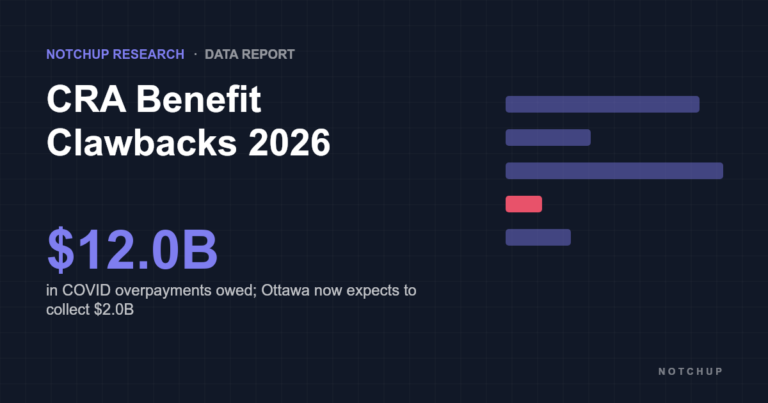
The OAS recovery tax clawed back $3.6 billion in 2024-25, more than any other benefit recovery the CRA reports. Our CRA benefit clawbacks report covers the 2026 threshold and how the recovery works.
Frequently Asked Questions
Are CPP and OAS payments taxable?
CPP is taxable income. OAS is taxable income. GIS is not. You’ll receive a T4A(P) for CPP and a T4A(OAS) for OAS at tax time. You can request that tax be withheld at source by contacting Service Canada — this avoids a large tax bill when you file.
What if I haven’t applied for OAS yet?
Service Canada automatically enrolls most people in OAS at age 65 if your information is already in their system. If you haven’t heard anything by your 64th birthday, apply proactively — payments aren’t retroactive past 12 months. You can apply online through My Service Canada Account or by calling 1-800-277-9914.
Can I delay OAS to get a higher amount?
Yes. You can defer OAS up to age 70. For each month you defer past 65, your monthly payment increases by 0.6%, up to a maximum 36% increase if you wait until 70. Whether deferral makes sense depends on your health and financial situation.
Do CPP and OAS amounts increase over time?
OAS is indexed quarterly to the Consumer Price Index and goes up with inflation. CPP is indexed annually each January. Both have increased in 2026 compared to 2025 levels.
What time does my CPP or OAS get deposited?
Direct deposit recipients typically see funds arrive by midnight on the payment date or early in the morning — most people have the money before 9 AM on the scheduled day. The exact timing depends on your financial institution’s processing schedule. If the payment isn’t showing by mid-morning, check with your bank first. If they confirm nothing is pending, call Service Canada at 1-800-277-9914 with your SIN ready.